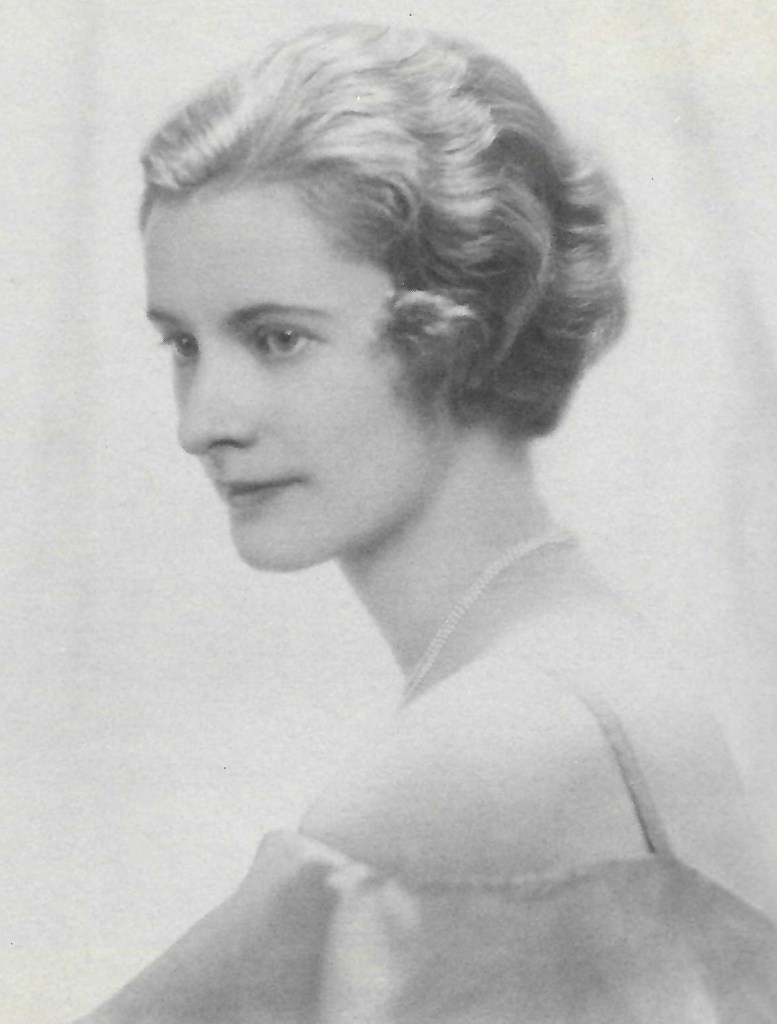
pic from Anne’s “coming out” party, guessing she was 18
You know, a peculiar thing sometimes happens when one is researching a long dead character: the attachment becomes personal, almost like a milder version of the Stockholm Syndrome. In Lorraine Tinsley’s book, “The Uncrowned King & the Desert Queen” about T.E. Lawrence and Gertrude Bell, she quotes Malcolm Brown (p.30) on his research into T. E. Lawrence’s letters, who speaks to this phenomenon: “He ceases to be a project and becomes a person in your life……… I found him a good companion.” And so it is with Anne Wilkinson.
Anne Cochran (Gibbons) Wilkinson (1910-1961) was one of the early, but lesser known, major Canadian women poets of the mid 20th century. Her brief life was one of privilege, tragedy, and genius. Her privilege came from her Osler and Gibbons heritage; her tragedies from various unfortunate life events; and her genius from her gifts with the English language.
Anne’s Connection to London
Through family on her paternal side, she had links to London, Ontario where she spent her childhood until her father’s untimely death.
My article, originally written for the London & Middlesex Historical Society Newsletter, on her life and her connections to London, Ontario can be found here. If one wishes to delve deeper, a reading list with comments is provided at the end of this page.
The Tamarack Tribute to Anne
In 1956 Anne was a co-founder and patron of the Tamarack Review, which came into existence following the death of John Sutherland and the demise of his Northern Review that same year. After Anne’s death in 1961, Ivon Maclean Owen wrote in the Summer Edition (#20) of the Tamarack Review the following moving eulogic introduction to one of her pieces published therein.

In addition, following her death, Robert Fulford wrote about her in the Toronto Star, May 23 1961. (From the Toronto Star Archives)

In the tenth Anniversary issue, then Editor Robert Weaver, again mentions
Anne’s contribution to the little magazine: “Without the late Anne Wilkinson we couldn’t have survived our first year.” Also in that anniversary issue are 10 unpublished poems, curated by Arthur (A.J.M.) Smith, who describes her as “one of the most intense and delicate of Canada’s Women poets.” AJM posthumously edited her manuscripts and notebooks which appeared in 1968, and were reprinted in 1990 under the title of “The Poetry of Anne Wilkinson and a Prose Memoir”.
AJM and Anne had a close friendship and his affection for her continued after her death. He states in “A Reading Of Anne Wilkinson” that upon hearing of her passing he read once again, at single sitting, all the poems she had written. “I seemed to be reading them for the first time. And I read with a newly sharpened awareness of small, immensely significant details of imagery, music, language, and emotion. There is a stanza of Emily Dickinson which describes the strange clarification brought about by death, and it kept running in my head as
a sort of counterpoint to what I was reading :
” We noticed smallest things,
Things overlooked before,
By this great light upon our minds
Italicized, as it ’twere.””
TV Hockey
TV Hockey is a quirky, playful, obscure, and charming little poem. I know the feeling of identifying one’s self with hockey when out of country. Thus I love this piece by Clarissa Aykroyd about Anne’s poem TV Hockey. Clarissa’s blog post can be found here. and here is the poem itself:
Players, humped as oxen, brood in boxes;
One by one stumble from their cages
(Lift of gulls, swing and loop and lag
And in amnesia trace
Archetypal dreams on sheets of ice).
Whistle blows, beaked sticks dart, peck
At the moving puck.
On tin white sky the little black moon spins.
Crowd is crowing; gulls
Glide in their swoon; tranquil
In a fold of mesh lies the black moon.
Anne as a pre-feminist era poet
Anne had to struggle with the conflicting duties of “motherhood/female expectations” and her need for creative release as a poet in essentially a male world. To gain a better understanding of how this is reflected in her life and poetry, please see Kristina Getz’s Ph.D dissertation “Portraits of the Artist as a Mother: Feminist Reconfigurations of the Maternal in Modern and Contemporary Canadian Literature.“ January 2022. The relevant section on ACW can be found on pages 62-70.
Frank Scott, Art (A.J.M.) Smith, and Anne Wilkinson
Francis Reginald Scott (1899-1985) and Arthur James Marshall Smith (1902-1980) were life-long friends and collaborators. In fact, Scott dedicated his 1945 book Overture to Smith plus his Collected Works (1981) to his memory, as Smith had died the year before.
Anne was a close friend of both men, having had an affectionate relationship of varying degree with each at different times. During Anne’s literary life the three were part of a coterie of Canadian poets that included James Reaney, Louis Dudek, P. K. Page, Phyllis Webb, Margaret Avison, Raymond Souster, and others.
In my estimation Scott was a decent guy, albeit a womanizer, and made many close friendships with folk as diverse as Leonard Cohen and Al Purdy. Women were naturally attracted to him. But he was married (in a seemingly open relationship but chained by familial responsibilities), and this lead to a few broken hearts, notably Pegi Nicol, P. K. Page, Anne Wilkinson, and Phyllis Webb.
As Sandra Djwa writes, “Pat Page had been greatly drawn to Scott when she first met him: “I saw this very interesting mind, that is what I saw. The vitality of it, electricity of it, quickness of it, the depth of it. And that’s what I fell in love with””
He was a brilliant poet, and wrote eloquently about social justice issues plus matters of the heart.
Charity is but one example of the former:
A code of laws
Lies written
On this beggar’s hand.
My small coin
Lengthens
The harsh sentence.
As one reads the latter set, (Union, Spring Flame, Laurentian, Signature, Departure, TO____, Question) one wonders which lover had inspired which.
One of my favorites of Scott’s is Departure written in 1944 after an initial “break up” with P.K. Page, which ends with the line “Events shall pass like waves, and we shall stay.” And that they did, remaining friends for life.
With regards to Anne, she met Frank at a dinner party in 1950 and it seems their friendship became intimate in July of 1951. Her poem The Swimming Lesson, was a result of their first intimate meeting and Scott’s poem TO___ was supposedly written in response to hers.
In May of 1954 Anne found out about Frank’s affair with Phyllis Webb, and broke off the relationship. In January of 1955 Anne writes in her journal “One good thing is to look back on my relationship with F. and to think it did no one any harm. And he has departed from my imagination as miraculously as he entered it. Nothing now could raise that phoenix.”
With regards to AJM Smith, they seem to have become lovers in the spring of 1956. Anne’s mother had died in January; she and her mom were extremely close, and Anne took her death extremely hard. (What are good friends for?) In June of that year she writes “And yet the year gave me AJM. Even if I never see him again, he has added a special bounty to my life, has made my skin shine, and my heart.”
Art Smith really was a true friend, both before and after Anne’s death from lung cancer in 1961. He posthumously published The Collected Poems of Anne Wilkinson and a Prose Memoir, in 1968.
The State of Canadian Poetry: 1954
In 1954 Louis Dudek wrote this essay on the subject of Canadian Poetry. It is an interesting read from those early days when decent poetry was starting to be written, or at least was being acknowledged more widely.
Here are a few lines of Anne’s that he gives as an example:
“I am so tired I do not think
Sleep in death can rest me.
So line my two eternal yards
With softest moss,
Then lengths of bone won’t splinter
As they toss,
Or pierce their wooden box
To winter . . .”
A CBC Audio file from 1984
In 1984 CBC Anthology broadcast a documentary about Anne, titled “Anne Wilkinson Remembered”. It is about 50 minutes long and is well worth a listen. The audio file can be found here
To Listen to Anne reading some of her poetry:
A Reading List
1) Coldwell, J. (1992). The Tightrope Walker. Toronto: University of Toronto Press.
This is really a first-class book, containing a transcription of the hand written journal of Anne between 1947 and 1956. It likely was not intended, at least by Anne, to be made public. It is spotty, in that there are stretches with no entries at all, but still an awful lot of her character, her experiences, and private thoughts come through.
It also contains several poems, plus some family type pictures along with an autobiography of the early part of her life.
Joan Coldwell has done a very thorough job with detailed explanatory end notes, a glossary of persons, and a chronology.
2) Irvine, Dean. (2003). Heresies. Vehicule Press
This is another impressive and exhaustive book, being the complete poems of Anne Wilkinson including the two main collections Counterpoint to Sleep (1951) and The Hangman Ties the Holly (1955). There are also poems from various periodicals and anthologies, plus unpublished poems from her copy-books.
Heresies has a lengthy introduction along with extensive notes. In fact, only half of the 321 pages are poems.
3) Wilkinson, A. C. (1956). Lions in the Way. Toronto: Macmillan.
This book, written by ACW, is primarily a history of the Osler family, incorporating letters and journals that were in Anne’s mother’s possession, or sourced from relatives and archives.
4) Acheson, Katherine Osler, https://canlit.ca/article/anne-wilkinson-in-michael-ondaatjes-in-the-skin-of-a-lion/
This article, originally printed in 1995, discusses the references to Anne Wilkinson in Michael Ondaatje’s “In the Skin of a Lion”. It can also be viewed here.
5) Dalgleish, Melissa A. Revealing Reciprocity: Anne Wilkinson, Northrop Frye, and Mythopoetics in Canada. Master’s thesis, Dalhousie University, September 2007
This is a fairly academic article, that attempts to determine what place Anne Wilkinson has in Canadian Literature. It can be downloaded here.
6) Armitage, Christopher Anne Wilkinson and her Works (1989)
This slim volume appeared at a time when not much was being, or had been, written about Anne Wilkinson, except perhaps for Robert Lecker’s “Better Quick than Dead: Anne Wilkinson’s Poetry” in 1978. Armitage goes through a number of Anne’s poems and provides some analysis. One of the interesting things about this volume is that over time certain of Anne’s poems underwent revision, and he points out some of the changes. He would not have had the benefit of Coldwell’s and Irvine’s take on certain poems, “The Swimming Lesson” being an example.
7) Ruthig, Ingrid The Essential Anne Wilkinson Porcupine’s Quill 2014
This slim volume of 63 pages is a selection of 24 of ACW’s poems curated by Ingrid Ruthig, that in her mind best illustrates the essence of Wilkinson’s work.
(It can still be obtained for a modest sum from the publisher, Porcupine’s Quill:
https://porcupinesquill.ca/bookinfo6.php?index=297 )
Along with a Forward that speaks about ACW as a poet and her relevance and place in the Canadian literary scene, Ruthig also concludes with a biographical sketch.
8) Mezei, Kathy “And We Are Homesick Still”: Home, the Unhomely, and the Everyday in Anne Wilkinson Journal Studies in Canadian Literature Volume 30, Number 1, Spring 2005 p. 160-180
This is a rather academic thematic analysis of the undercurrent of domesticity that runs through Wilkinson’s work as a counterpoint to the challenge of being a modern 20th century Canadian poet. It can be found here. Whatever Al Purdy might have thought about such a thesis, I would probably agree with.
 Symbols of Perspiration